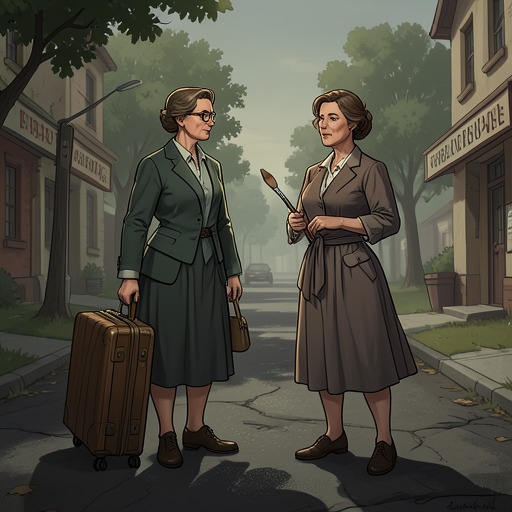
Eve leaves her husband and relocates to Hope Creek
Lost and FoundEve Waters’s move to Hope Creek is a self-directed escape from a marriage that had steadily narrowed her life. After Bryan, her college sweetheart, cheats on her, she leaves rather than fight over what remains, accepts the financial cost of their divorce, and takes an overqualified job in a small-town restaurant. A month into this quieter existence, she is still carrying the damage of the previous six months, but the distance has given her room to begin again.
Marriage and the decision to leave
Eve’s departure follows years with Bryan, whom she had loved since college and married without a prenuptial agreement. She recalls having been fooled into letting him put a ring on it, then spending years catering to him before discovering his infidelity. The relationship’s end is not presented as a sudden quarrel: her account links the betrayal to a longer erosion of self. By the time she leaves, she has lost not only her will to cook but also the sense of herself that professional cooking had once helped define.
The divorce brings a material consequence alongside the emotional one. Bryan takes half of everything she had, and Eve’s cash is at an all-time low. She knows he understands that he has done wrong, yet she does not try to turn that recognition into a fight over money. She gives him what he wants because removing him from her life matters more to her than contesting the division. Leaving is therefore a choice with a price: she gives up security and possessions in exchange for a clean break, not because the loss is negligible but because continued attachment would cost her more.
A deliberately smaller life
Hope Creek offers a sharp contrast with the life Eve has left. The town has one stoplight; its pace is slower, its residents seem genuine, and they do not press her to disclose every part of her history. That lack of scrutiny suits someone hoping to forget at least some of her past. After a month there, she describes the town as what she needed, even while acknowledging that its loneliness and wholesome small-town character take adjustment.
Her work reflects the same retreat. Eve is a professional chef, yet she takes a job for which she is markedly overqualified at a hole-in-the-wall restaurant in what she regards as a dirt town. The choice is not evidence that she has ceased to be a chef; rather, she has lost the will to cook during her marriage and needs an escape before she can recover that part of herself. The job trades professional standing for distance from the life that had exhausted her. Its modest scale is part of its appeal: Hope Creek lets her step away from the expectations attached to her former life without requiring her to explain the step to everyone around her.
The costs and signs of relocation
The move does not immediately make Eve feel settled or financially secure. In her battered pickup, she follows a dirt road while a Beyoncé CD skips in the player. She has listened to the album repeatedly since the divorce, and its songs give her a language for the marriage, the betrayal, and the aftermath. When the music falters, her outburst about needing an upgrade for her entire life turns an unreliable old truck and a malfunctioning CD into a compact expression of how little feels dependable. The financial reason she cannot simply replace things is explicit: the divorce settlement has left her with little cash.
The truck also makes the move concrete. Eve is not simply imagining a different life; she is driving through the countryside in an old pickup, carrying the dents accumulated through high school, college, and marriage. The vehicle has been dependable even as those dents record successive stages of her life. Her insistence that it does not define her marks a distinction between the visible, worn-down evidence of her past and the identity she hopes to reclaim. Relocation gives her space, not instant renewal.
A beginning rather than a resolution
After a month in Hope Creek, Eve has survived the isolation without driving herself crazy, and she regards the slower pace as necessary. Yet she remains guarded, and the contrast between escape and loneliness persists. The town’s apparent genuineness is something she must get used to; privacy is a relief precisely because she is not ready to recount the life she wants to leave behind.
The move’s significance lies in its combination of loss and agency. Eve leaves the marriage after Bryan’s cheating, accepts a severe financial setback rather than prolonging the conflict, and chooses work below her professional level in a place far removed from the life she had known. These choices do not erase the divorce or restore her appetite for cooking at once. They establish the conditions for recovery: a smaller, slower life in which she can keep her past at a distance and decide what remains hers.